
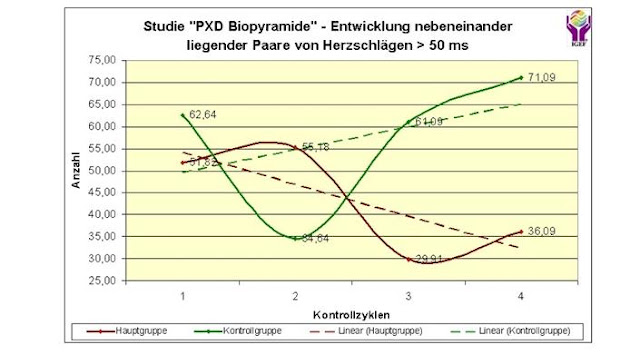
Equilibration of the internal balance with frequent interval jumps is necessary with a higher load, i.e. the number of pairs of heartbeats, which indicate a difference greater than 50ms, increases. Their number in the period of testing observed pairs is processed. The program of successive IBI differences automatically eliminates differences that are psychologically impossible. All measurement records are determined as filtered raw data for heart rate variability, the level of 25% can be accepted as an upper limit. Heart rate variability values due to sudden movements or other confounding variables are also ignored.
Generally, stimulation of the parasympathetic works with a second rate and in this way affects the resting activity of the heart. An increase in the activity of the parasympathetic leads to a slowing down and an increase in the number of heartbeats.
In contrast, the sympathetic nervous system can only work with slow heart rate changes. Long-term biological effects of electrosmog or geo-biological fields with a harmful effect increase the activity of sympathetic nerves. In order to avoid this irritation, sooner or later the normal values of the body's rhythmic processes are changed. According to the reaction type, the respondents show different psychological reactions, which basically can have a unique energetic basis.
Overview of measured sizes:
| Measurement values nn50 | ||
| Cycle | GK | KK |
| Control cycle 1 | 51.82 | 62.64 |
| Control cycle 2 | 55.18 | 34.64 |
| Control cycle 3 | 29.91 | 61.09 |
| Control cycle 4 | 36.09 | 71.09 |
| CB | 45.64 | 52.79 |
 |
| QHRS Biopyramid study, development of consecutive pairs of heartbeats > 50ms |
The trend line of the development of pairs of heartbeats with a difference between heartbeats greater than 50ms, which describes the respondents from the main group, clearly decreases during the testing period. The vegetative nervous system acts with a decreasing balance as a result of the reduction of external influences by the QHRS biopyramid.
In subjects from the control group during the test period, the trend line of pairs of heartbeats with a difference of more than 50 ms increases. According to the current loads of these beats in the environment of the examinee, their number also changes during the test control cycles.
