
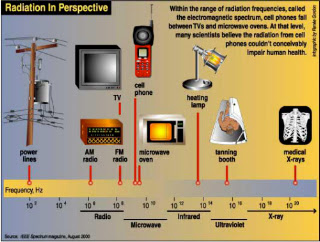
The electromagnetic spectrum can generally be divided into two parts: ionizing radiation and non-ionizing radiation. In principle, all ionizing radiation, even at low levels, can be dangerous, while non-ionizing radiation is usually safe, except at very high levels.
Excessive or intense exposure to any species can be harmful. For example, visible light is not harmful, but if amplified enough it can blind or even burn the skin.
In general, ionizing radiation is high-energy waves and all are harmful, even in small amounts, such as gamma rays, X-rays, and ultraviolet waves. These types of radiation cause ionization of atoms and molecules, which leads to the destruction of molecules in the cell and DNA. If the DNA is destroyed in a cell, then the cell can be cancerous.
 Low-energy waves, such as visible light, infrared radiation, and radio waves are not harmful (again, except in extreme cases). Exposure to high levels of visible or infrared radiation (for example from a powerful laser) can cause blindness and can burn the skin.
Microwaves are low-energy waves that are actually quite harmful. Intense exposure to microwaves can cause tissue heating, potentially causing severe burns.
Of the low-intensity microwaves with which we are surrounded, we can single out:
- Mobile phones operate at 900 MHz to 1.8 MHz
- Cordless phones operate at 900 MHz and 2.4 GHz
- Wireless Internet works on frequencies of 2.4 GHz and 5.8 GHz
- Bluetooth, wireless keyboard and mouse operate at around 2.4 GHz
- Newer computers and laptops operate at over 1.5 GHz
- Radar installations operate from 6 GHz, say airport and area flight control
If you want protection from these radiations, read more about our certified products QHRS BioPiramid and
QHRS MobiChip.


