
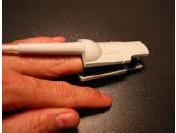
During this process, the light source projects infrared light onto the surface of the skin and all the reflected light is received by the photoelectric sensor. With each beat, the heart pushes blood through the peripheral blood vessels. The difference in reflected light corresponds to the difference in peripheral blood volume. During this measurement, the difference between the maximum and minimum required amount of blood within the framework of the heart rhythm, the so-called pulsating volume amplitude, is determined. The more blood there is in the area being examined, the more light will be absorbed and will not be registered with the photoelectric sensor. Recalculation of the amount of ejected blood at each heart beat and peripheral resistance allows obtaining heart beats (beats per minute).
The values shown by the flow curve of the required amount of blood represent the blood circulation in %. Under stress under the influence of sypaticus, blood pressure rises and blood vessels constrict, which indicates a decrease in circulation.
The values shown by the flow curve of the required amount of blood represent the blood circulation in %. Under stress under the influence of sypaticus, blood pressure rises and blood vessels constrict, which indicates a decrease in circulation.
It should be emphasized that during electrostress the number of red blood cells increases, which optically appears as a signal to reduce the flow of the required amount of blood. Heart rate and pulsating amplitude are influenced by sympathetic and parasympathetic. This signal is especially manifested in l tested subjects with reduced peripheral circulation.
Any reduction in the flow of the required amount of blood
produces a reduction in the body's supply of nutrients and oxygen, and certainly leads to the supply of toxic substances to the cells through the blood vessels.
Today, more than 20 million people suffer from diseases of the heart and blood vessels, and that number is gradually increasing. These include arteriosclerosis, myocardial infarction, as well as peripheral damage to blood vessels.
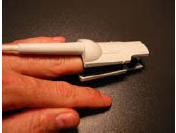
Due to all of the above, the effects of electromagnetic radiation and geobiological fields with a damaging effect on changes in blood flow and the required amount of blood are of particular importance and are specifically recorded in the measurement records. The BVP sensor is placed on the little finger of the right hand in all subjects.

