
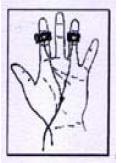
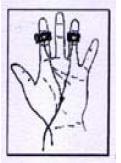
 With this sensor, the bioelectrical properties of the skin (described as both resistance and permeability of the skin) can be captured. In doing so, a low, constant voltage of 0.5 V is maintained with 2 electrodes on the main skin area.
Depending on the activity of the sweat glands, existing gender variations between the two sexes can be measured in µS (Mikro-Siemens). In proportion to the increase in the measured amount of sweat during irritation, the conductivity of the skin increases. At the same time, in accordance with physical laws, the resistance of the skin decreases. Stress stimuli are manifested through an increase in the level of skin conductivity. However, the latency time after the reaction of increasing skin conductivity is also an interesting data registered by the EDA sensor.
Skin conductivity is exclusively a function of the sympathetic part of the autonomic nervous system and is one of the most important indicators of stress reaction. For the purposes of this analysis, during all measurements, and
for the purpose of comparing information, all electrodes of the EDA-sensor were placed on the distal parts of the index and ring finger of the right hand of the subject.
Measured values are graphically represented in units of measurement µS (Mikro-Siemens), where the i-axis also represents the time axis of the record.
